Why buyers are reviewing alternative production origins
Changes in U.S. trade measures, freight, capacity and inventory risk can change the economics of a sourcing route. Philippine production can be worth evaluating, but only a like-for-like comparison is meaningful. A lighter board, fewer colors, different coating, lower pallet protection or optimistic container count can make one quotation appear cheaper while changing the product and risk.
The proposed manufacturer is Double Philippine Packaging Products Corporation in Calamba City, Laguna. It is a PEZA-registered export enterprise. PEZA status does not by itself establish U.S. tariff treatment, origin, preferential duty or exemption for a shipment.
Freeze the specification before comparing countries
| Comparison field | Keep constant | Evidence |
|---|---|---|
| Finished box | Inside dimensions, style, lock, vents and tolerance. | Controlled dieline and approved sample. |
| Corrugated board | Flute, liners/medium, basis weight or agreed performance target. | Material specification and finished-box test plan. |
| Printing | Artwork revision, colors, coverage, varnish/coating and code requirements. | Color separations, proof and production standard. |
| Food-contact scope | Actual liner, ink, coating, adhesive, contact condition and required evidence. | Current documents tied to named materials. |
| Packing | Bundle count, pallet footprint/height, restraint, labels and moisture protection. | Approved packing drawing and loading plan. |
| Commercial volume | Annual units, SKU mix, order cadence, forecast and launch timing. | RFQ volume table and quotation assumptions. |
Calamba production capability to qualify
The documented main line is a K6-1200 × 2400 three-color flexographic printer with varnishing, vacuum transfer, slotting and rotary die cutting. It has a documented maximum feed of 1180 × 2400 mm and maximum print area of 1150 × 2400 mm. Management also reports a 16-head digital printer, folder-gluer, standalone die cutter and stitcher. These facts define review inputs, not an automatic commitment for every size, board, artwork or running speed.
Build the landed-cost worksheet openly
- Factory: unit price by quantity, tooling, plate/die ownership, setup, sample and inspection costs.
- Philippine inland: plant-to-port trucking, terminal and documentation charges.
- Ocean: container type, freight, surcharges, insurance and expected transit assumptions.
- U.S. entry: classification, duty and other measure assumptions confirmed by the importer/broker; brokerage, bond, merchandise-processing and port charges as applicable.
- Domestic delivery: drayage, transload, warehousing and final distribution.
- Inventory: order size, days of supply, financing, safety stock and obsolescence by artwork version.
- Risk: delay, damage, quality escape, rework, rejected food-contact evidence and emergency replenishment.
Record the date and owner for each input. A total without assumptions is not a defensible sourcing decision.
Origin and document consistency
Origin is based on actual manufacturing facts and the rule applicable to the entered product. It cannot be created by routing goods through the Philippines, using a Philippine invoice or loading at a Philippine port. Purchase orders, raw-material records, work orders, production and lot records, packing lists, invoices, origin support and transport documents should tell one consistent story.
- Name the real legal manufacturer and Calamba address.
- Identify raw-material suppliers and trace the board, ink, coating and adhesive lots used.
- Retain job tickets, machine/production records, inspection results and finished-lot identification.
- Match product descriptions, dimensions, quantities, weights and parties across commercial and transport documents.
- Have the U.S. importer or customs adviser determine the classification, origin statement and entry treatment before shipment.
- Do not describe a quote as duty free, tariff free or exempt without a transaction-specific written basis.
Flat-pack pallet and container questions
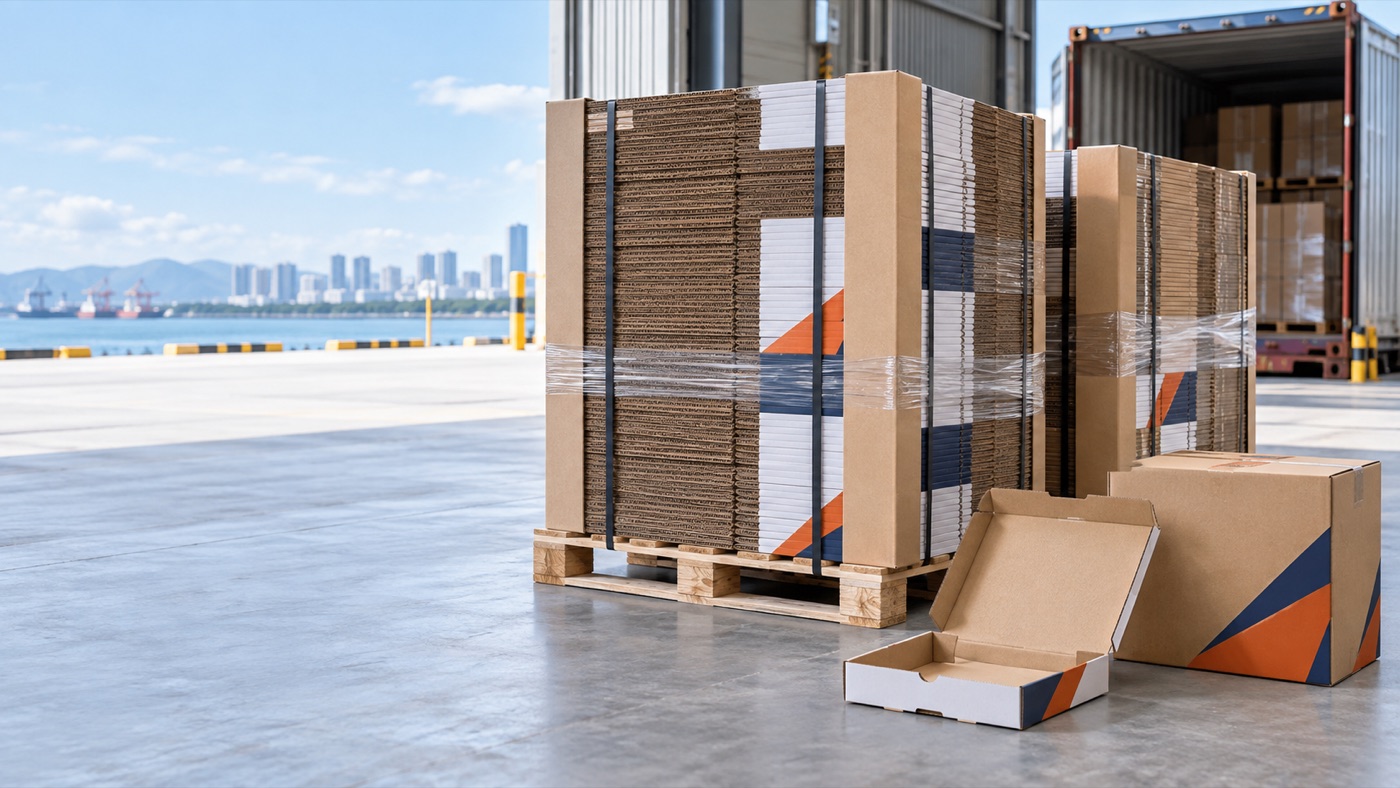
Pizza boxes normally ship flat, so economics depend heavily on bundle compression, pallet cube, weight, protection and receiving constraints. The approved plan should state bundle quantity and orientation, pallet footprint and maximum height, corner/edge protection, straps or stretch wrap, moisture barrier, pallet labels, container loading pattern, floor loading, dunnage and warehouse handling method.
Do not promise a container quantity from nominal box dimensions alone. Use production-representative bundle dimensions and weights, then test the loading plan against container and route limits.
U.S. importer RFQ package
- Company, importer of record and customs-broker contact.
- Destination port, warehouse and requested Incoterm with named place.
- Annual and order volume by SKU, forecast and launch date.
- Dieline, finished dimensions, board specification and performance tests.
- Artwork, color and coating requirements; version-control process.
- Food-contact evidence required by the buyer and intended use.
- Bundle, pallet, container and receiving constraints.
- Required origin, commercial, quality and transport records.
- Inspection, sample, route-trial and change-control requirements.
Frequently asked questions
Are Philippine pizza boxes duty free in the United States?
No such promise is made. The importer and customs broker must confirm classification, actual origin, current trade measures and all charges for the planned entry.
Does PEZA registration establish U.S. origin or duty?
No. PEZA is a Philippine registration. U.S. origin and entry treatment depend on actual manufacturing facts and applicable U.S. rules.
How do I compare the Philippines with China?
Use the same finished specification, volume, packing and commercial assumptions, then compare all factory, logistics, entry, inventory and risk costs.
Can you guarantee a container quantity?
Only after the flat-box bundle, pallet plan, weights, container type and route constraints are approved. Nominal pizza size is insufficient.
Request a comparable Philippine-origin quote
Send the controlled specification, annual quantity, SKU mix, food-contact document list, destination, Incoterm and pallet/container requirements. The response will identify the proposed plant and every commercial assumption.
Request a U.S. importer quote →