1. Freeze an equivalent product before comparing cost
A lower price may reflect a different inside size, liner, flute, basis weight, recycled-content policy, print coverage, varnish, joint, bundle count or tolerance. Create one controlled specification and require each bidder to identify substitutions. Include food-contact documentation requirements and a physical production standard; otherwise “same size” quotes are not necessarily comparable.
2. Calculate units from a verified packing plan
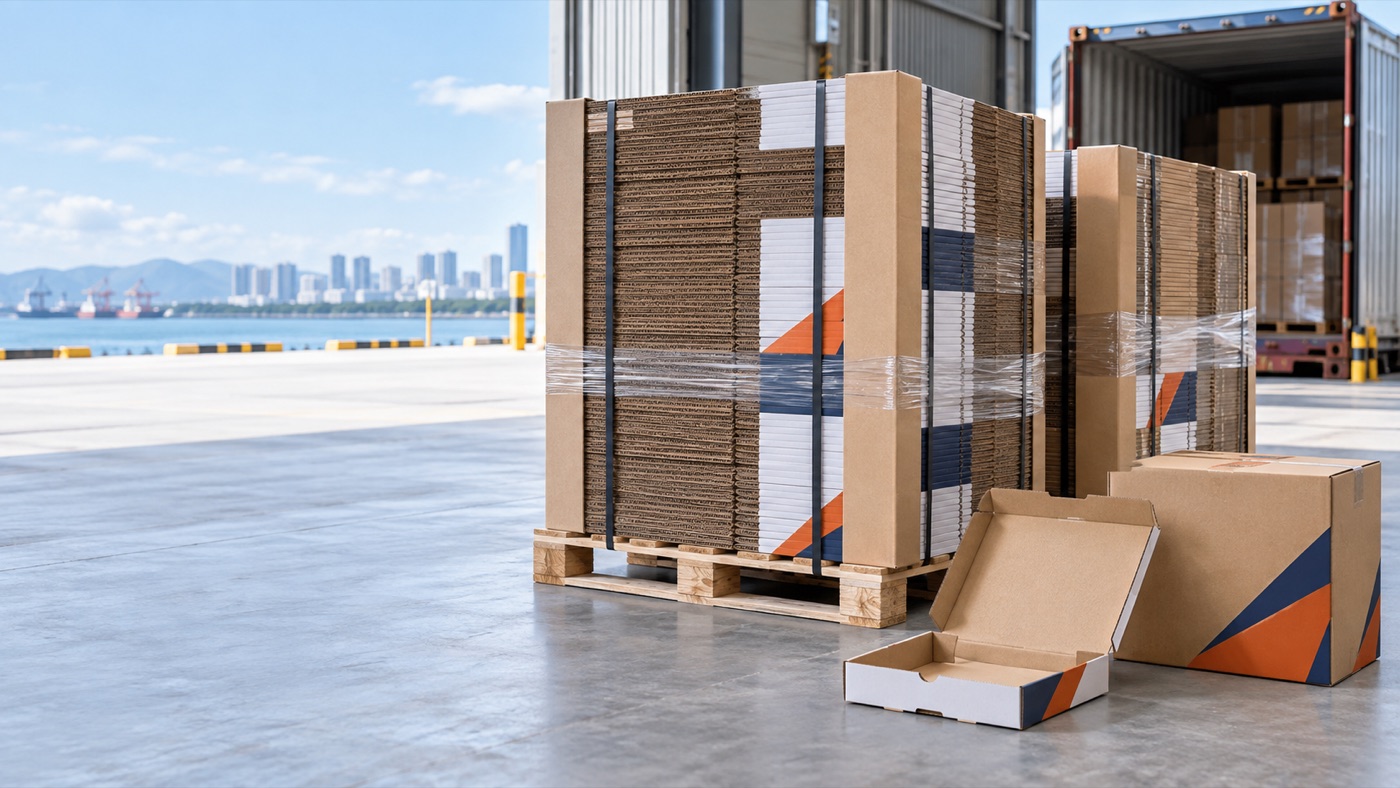
Flat pizza boxes are often volume-limited. Use the approved blank and bundle—not an estimate from nominal pizza diameter—to determine bundle dimensions and weight. Then measure units per pallet and per container under realistic height, weight, floor-loading, moisture-protection and unloading constraints. Reserve space for pallet material, corner protection, straps or wrap and required ventilation.
| Loading input | Evidence | Risk if assumed |
|---|---|---|
| Blank and bundle dimensions | Approved sample and packed bundle measurement | Container count overstated |
| Bundle quantity/weight | Packing instruction and scale record | Handling, counting or weight mismatch |
| Pallet pattern/height | Layer drawing and trial pallet | Overhang, compression or unused cube |
| Container plan | Loading diagram with total packages, units, net/gross weight and volume | Freight per usable box understated |
3. Use a complete landed-cost equation
Run at least three freight and utilization scenarios rather than one optimistic figure. Add the cost of forecast error, ocean lead time, safety stock, artwork obsolescence and minimum quantities by size. A domestic or regional supplier may have a higher unit price but lower working capital and change risk; an import program may improve cost only when volume, specification stability and container use justify it.
4. Separate Incoterm from landed cost
FOB, CFR, CIF, DAP and other Incoterms allocate specified delivery tasks, costs and risks between buyer and seller; they do not settle tariff classification, customs value, origin, importer-of-record responsibility or every local charge. Record the named place and Incoterms edition in the quotation, then map costs that remain with the importer. Ask who books freight, supplies verified gross mass, clears export, provides draft documents, pays destination charges and manages demurrage or detention.
5. Verify current U.S. customs treatment
The U.S. International Trade Commission's current Harmonized Tariff Schedule sets out tariff provisions and rates; U.S. Customs and Border Protection interprets and enforces the HTS. Product description, material, construction and use affect classification. Chapter 99 measures and other provisions can change, so save the broker's analysis and entry-date source rather than relying on a supplier's website.
Also ask whether any antidumping or countervailing duty order, scope ruling, circumvention determination or other trade measure could apply. The U.S. Department of Commerce explains that an AD/CVD scope defines the technical merchandise to which a measure may apply and that cash-deposit rates can change. A different shipping country, producer or exporter does not by itself resolve scope or origin.
6. Build an origin evidence file
| Record group | Requested facts | Purpose |
|---|---|---|
| Parties/site | Legal manufacturer, address, exporter, seller and bank beneficiary | Connect the quote and entry to real entities |
| Manufacturing | Board receipt, printing, slotting/die cutting, gluing/stitching and packing records | Document where relevant operations occurred |
| Materials | Supplier, grade, origin and lot records for board and other inputs | Support production and origin analysis |
| Shipment | PO, invoice, packing list, export declaration, transport document and package marks | Reconcile goods, parties, quantity, value and route |
| Origin statement | Any required certificate/statement and the rule it invokes | Support a claim under the applicable requirement |
The Philippine Bureau of Customs' export guidance lists the export declaration, commercial or pro forma invoice and packing list among core submissions and notes that other documents may be required. Document availability is not the same as U.S. legal sufficiency; send drafts to the importer's broker before loading.
7. Trial the complete route
- Approve drawing, materials, print, food-contact evidence and inspection criteria.
- Produce and inspect a representative trial lot on the proposed manufacturing route.
- Verify bundle, pallet and container measurements and protection.
- Expose the trial to representative ocean/inland handling and storage.
- Test restaurant assembly, stack, hot pizza, steam, grease and delivery time.
- Record rejects, labor, damage and customer-use feedback, then recalculate cost per usable box.
8. Use a go/no-go comparison
- Equivalent specification and current material evidence approved
- Verified units per bundle, pallet and container
- Broker-reviewed classification, valuation, origin and trade-remedy assumptions
- Complete landed-cost model with low/base/high freight and reject scenarios
- Approved production, logistics and restaurant-use trial
- Named owner for artwork, document and material change control
- Contingency stock and alternate-supply plan
Frequently asked questions
Can the supplier tell me the final U.S. duty?
The supplier can provide product and production facts. The U.S. importer and its broker or trade counsel should determine classification, customs value, origin, AD/CVD scope and other measures for the planned entry date.
Should I compare cost per thousand boxes?
Use it as one view, but also calculate cost per usable box delivered and cost per restaurant/order served. Include rejects, storage, handling, working capital and operational disruption.
Can North or South Harbor be used?
Management states that Manila North Harbor and South Harbor routes can be considered. The actual port, carrier, container availability, charges and schedule must be confirmed in the shipment quotation.
Does PEZA status eliminate U.S. import costs?
No. PEZA status is part of the Philippine plant context; it does not decide U.S. classification, duty, trade remedies, origin or destination charges.
Request a trial and loading quotation
Send the controlled pizza-box specification, annual volume by SKU, U.S. destination, pallet rules, required documents and target launch date.
Request a U.S. importer quote →