
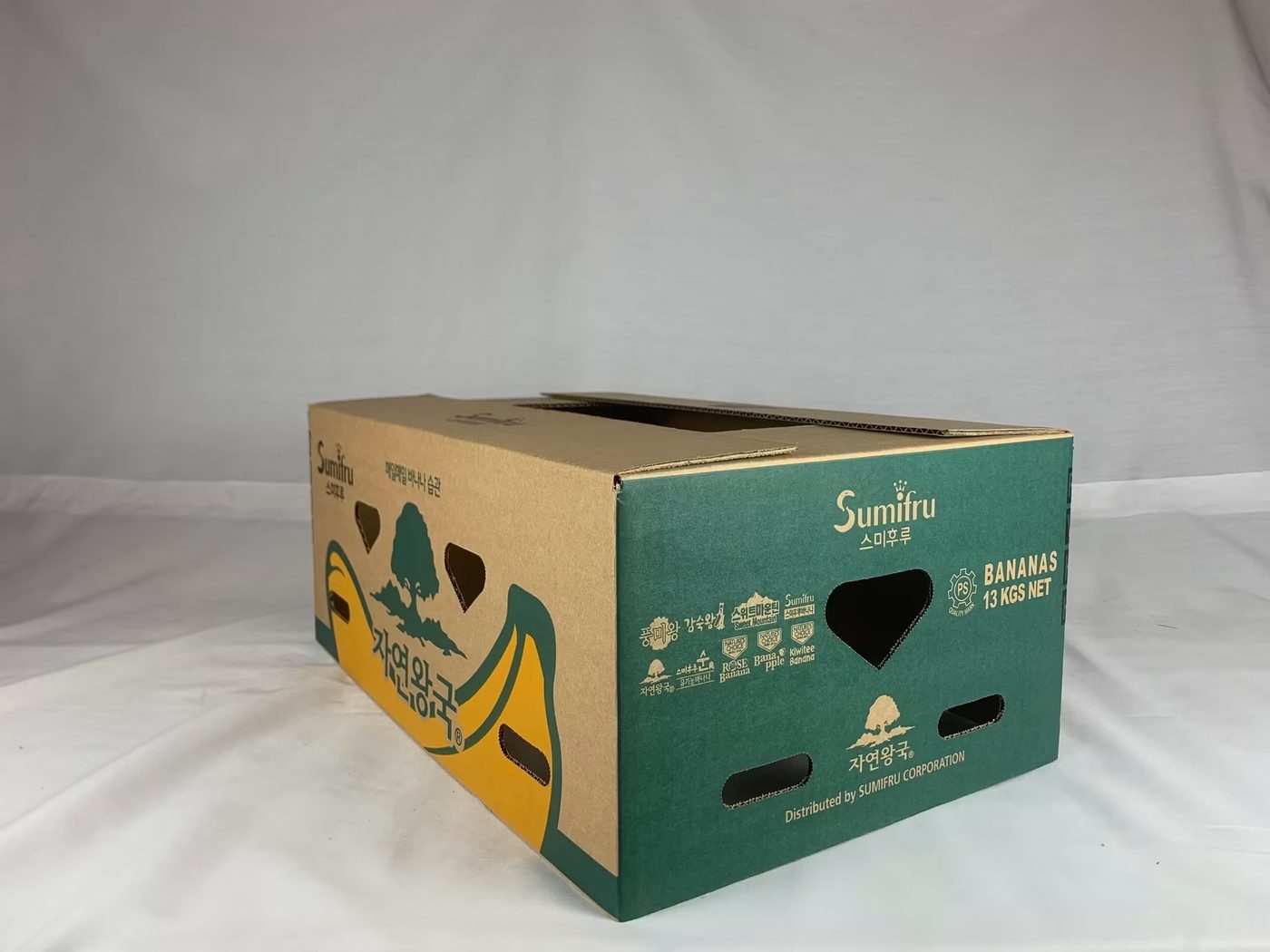
Bananas are shipped green, respire heavily and bruise easily, while route duration, temperature, humidity and ventilation depend on the buyer's postharvest program. The carton is a structural and ventilated part of that cold chain. Validate board, vents, moisture exposure and stacking with the actual fruit, pallet, reefer settings and route rather than a generic voyage duration.
The global standard is the 13 kg (28.6 lb) telescopic carton, roughly 500 × 400 × 244 mm, which stacks 48 boxes per pallet layer pattern in a 40' reefer. Middle East and some Asian markets prefer the 18 kg format. Both consist of a lid, a bottom tray, and often an internal pad. If your buyer has not specified, ask which supermarket program the fruit is destined for — the retailer usually dictates the format.
A banana carton at the bottom of a reefer stack carries over 200 kg for a month in near-saturated humidity, which can halve the compression strength of ordinary board. That is why most export banana cartons use BC double-wall (5-ply) construction with wet-strength (WS) or semi-wet-strength liners. Ask your supplier for the BCT (box compression test) value at 90 % relative humidity, not just the dry figure. Fuxing Group produces A/B/C/E flute combinations in 3, 5 and 7 ply and tests compression in-house.
Ventilation holes must align vertically through the whole pallet so forced-air cooling can pull air through the fruit. Typical designs use 4–6 side vents plus hand holes that double as airflow paths. Poor vent alignment is one of the most common causes of arrival ripening claims. We die-cut vents to match the pallet pattern of your specific stacking program.
Condensation and humidity exposure vary by route and handling. Compare wet-strength liners and barrier treatments with conditioned-board and finished-carton tests. Ask the receiver's actual paper-recovery program whether it accepts the approved coating; “water-based” alone does not prove recyclability.
Banana cartons are the most visible branding surface in a wholesale market. High-graphics flexo printing (up to 4 colors) with GMI-certified quality control keeps brand colors consistent across production runs — we hold GMI certification for direct-print corrugate and print programs for brands such as Del Monte, Unifrutti and S&W. See our full banana carton range.
For the full factory-side buying guide — programs, pallet and container math, board-grade checklist, MOQ and lead times — see Banana Carton Manufacturer: Buying Export Boxes in Bulk.
Packing avocados on the same humid cold chain? See the avocado export packaging guide: 25 lb and 4 kg boxes, harvest crates and container loads.
Send size, load, route, quantity and required date; the reply will state the quote basis, test questions and achievable schedule.