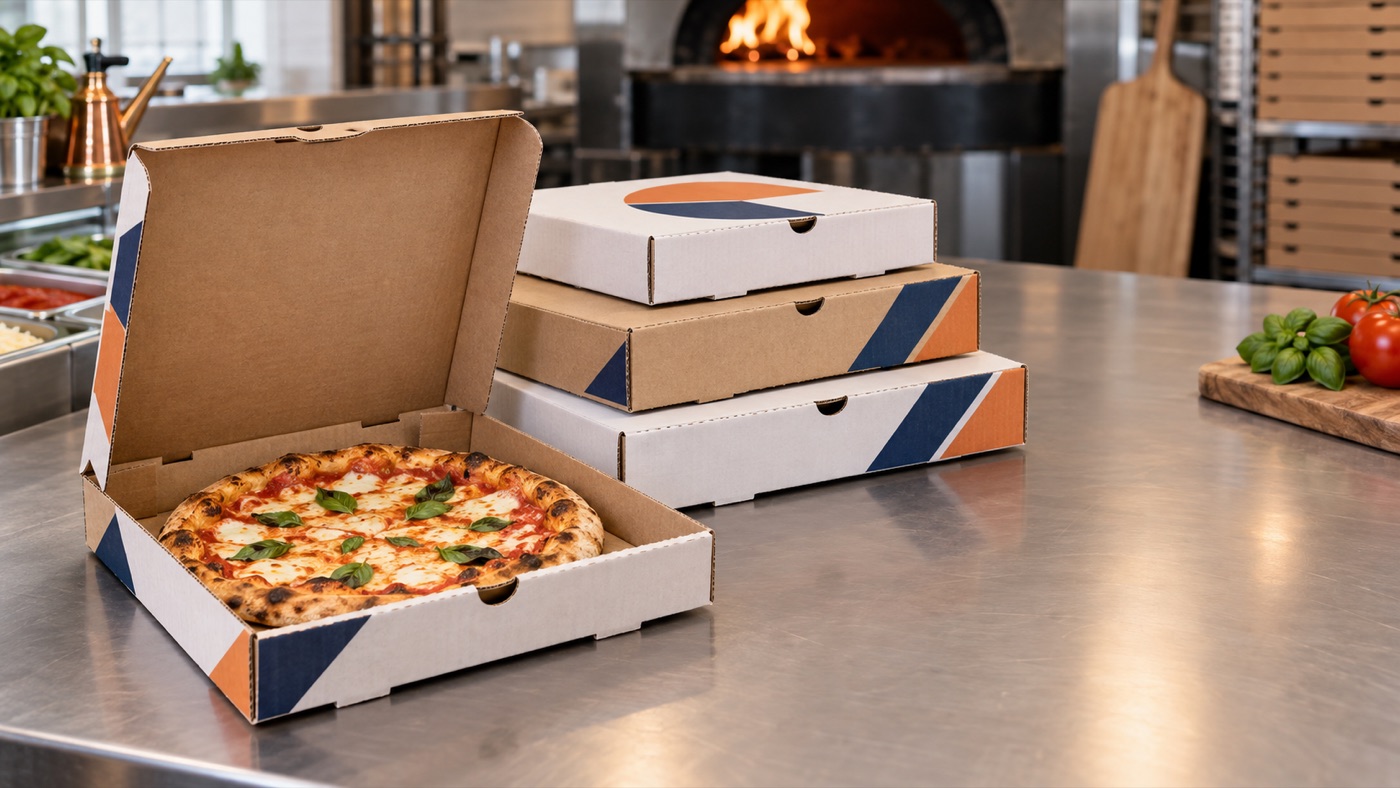
1. Do not order by pizza diameter alone
A “12-inch box” can differ in actual inside dimensions, usable height, lock geometry, venting and board. State the pizza or pan diameter, crust profile, maximum topping height, liner or insert and required clearance. Then specify the finished inside length, width and usable height in millimetres. If you are matching an existing box, send an assembled and flat sample plus the controlled artwork—not only a photograph.
| Input | Buyer should provide | Why it changes the box |
|---|---|---|
| Food format | Diameter, height, weight, pan/liner and serving style | Controls clearance, base support and lid contact |
| Service condition | Pack temperature, hold time, delivery time and bag use | Affects steam, moisture, heat retention and handling |
| Stack | Maximum boxes per rider/bag or store stack | Affects panel stiffness and vent obstruction |
| Operation | Manual/automatic erection, assembly target and storage space | Affects lock design, blank size and bundle method |
2. Connect board choice to actual service
Ask the supplier to identify the inside liner, outside liner, medium, flute and any treatment or coating. Describe grease, moisture, temperature, delivery time and stacking rather than requesting a vague “strong food-grade board.” If recycled content, virgin-fiber contact surface or a particular sourcing policy matters, write it into the RFQ and require the exact proposed construction in the quotation.
3. Treat vents and locks as one system
More vent area is not automatically better. Vent geometry can release steam but also influence heat loss, dust pathways, panel strength and alignment when boxes are stacked. Review vent location together with lid tuck, side locks, corner construction, hand-opening behavior and delivery-bag conditions. Trial the assembled box with the representative pizza; a flat blank inspection cannot show how it behaves in service.
4. Ask for construction-specific food-contact evidence
“Pizza box” is a format, not a compliance certificate. The buyer should define the destination and its own supplier-approval standard, then request evidence for the exact materials and intended use. At minimum, review:
- The identity and supplier specification of the food-facing liner.
- Whether contact is direct, separated by a liner or limited to expected incidental contact.
- Ink, varnish and coating composition and which surfaces can contact food.
- Adhesive identity, application location and supplier documentation.
- Food type, temperature and contact duration covered by any declaration or test.
- Document issuer, referenced material code, test conditions, date and current validity.
- Change-control rules for liner, ink, coating, adhesive and production route.
5. Control artwork for store operations
Provide a vector file on the approved dieline, with revision, spot colors, legal copy, branch/version rules and any QR or barcode data. Decide whether small text and variable artwork fit flexographic or digital production. The Calamba plant has a documented three-color flexographic line plus varnishing; management also reports a 16-head digital printer. Process selection, color result and economical run size require artwork and SKU review.
| Approval | Check | Evidence to keep |
|---|---|---|
| Content | Brand, address, warnings, ingredients/allergen copy owner and promotions | Signed artwork revision |
| Color | Spot-color references, allowable variation and kraft/white substrate effect | Approved physical standard |
| Code | Correct data, size, quiet zone, contrast, placement and final scan | Data record and production scan |
| Version | Size, language, campaign, branch or franchise variant | SKU-to-artwork matrix |
6. Specify bundle, pallet and delivery
Flat boxes consume store and warehouse space. State the bundle count and orientation, strap or wrap, pallet footprint and maximum height, labels, moisture protection, truck restrictions, delivery schedule and number of drop points. Ask for units per bundle, pallet and truck as quoted outputs—not universal web figures. For multi-branch programs, compare consolidated DC delivery with direct branch drops using current route costs and receiving capacity.
7. Run a production-representative trial
- Drawing and document review: freeze dimensions, materials, artwork and required evidence.
- Assembly trial: time erection and check locks, cuts, score cracking and operator handling.
- Hot-food trial: pack the intended pizza at representative temperature and hold/deliver for the real time window.
- Route trial: evaluate steam, grease marks, sag, lid contact, stack, venting, carrying and arrival condition.
- Release: record pass/fail rules, approved sample, revision, inspection frequency and change control.
Copyable pizza-box RFQ
Frequently asked questions
Can I approve the box from a digital proof?
A digital proof helps approve content and layout but does not prove dimensions, locks, stiffness, color on the actual liner, food-contact construction or hot-delivery performance. Use a physical production-representative sample.
Can every color be printed on the main flexographic line?
The documented line has three print colors plus varnishing. Some multi-color or variable designs may be evaluated for the management-confirmed digital route. The artwork, substrate, quantity and required result must be reviewed first.
What MOQ and lead time should I expect?
There is no reliable universal number. Size, board, print process, tooling, number of versions, packing and schedule affect both. Request an order-specific quotation with sample and production dates.
Where is the proposed plant?
Double Philippine Packaging Products Corporation is in Calamba City, Laguna, in the Manila-area industrial corridor—not Manila City.
Qualify one pizza-box SKU first
Send the current box or dieline, inside dimensions, food and route conditions, artwork, quantity, delivery point and required documents.
Request a Philippine pizza-box quote →