Quick answer
Raschel is warp-knitted and leno is woven; tubular mesh feeds compatible packing lines. Do not assign price or performance by construction name alone. Compare approved samples at the same dimensions, grams per bag, closure, load, crop, handling and route, and record stretch, snagging, seam performance and product condition.
The three constructions, compared
All three are extruded polyolefin tape or yarn turned into an open mesh, but the way the mesh is formed decides how the bag feels, stacks and prices.
| Raschel mesh bag | Leno mesh bag | Tubular mesh (roll stock) | |
|---|---|---|---|
| Material / build | Warp-knitted HDPE tape | Woven PP tape, locked cross-weave | Knitted HDPE / PA tube on rolls |
| Feel & behavior | Soft, stretchy, conforms to the crop | Firm, holds its shape, stacks neatly | Continuous tube, cut and clipped in line |
| Typical loads | 5–25 kg (up to 30 kg heavy-duty) | 10–30 kg, sharp or dense loads | 0.5–2.5 kg consumer packs |
| Best for | Onions, potatoes, citrus, cabbage | Root crops, corn, shellfish, firewood | Citrus, limes, avocados, garlic |
| Price basis | Request current quotes at the same dimensions, grams, closure, color, label/print, packing, quantity, factory and delivery basis | ||
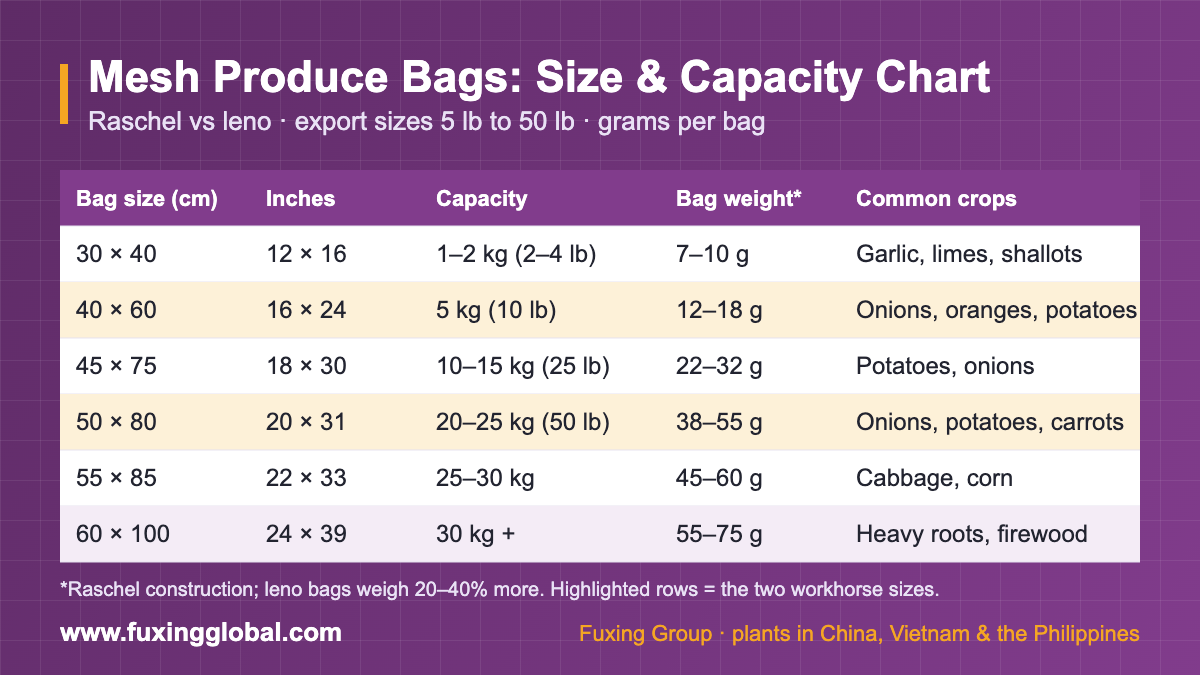
Mesh produce bag size and capacity chart (export standard)
US programs usually stock 5 lb, 10 lb, 25 lb and 50 lb equivalents; export programs specify width × length in centimetres. Custom widths and lengths are standard practice, not a special order.
| Bag size (cm) | Approx. (inches) | Capacity | Typical bag weight* | Common crops |
|---|---|---|---|---|
| 30 × 40 | 12 × 16 | 1–2 kg (2–4 lb) | 7–10 g | Garlic, limes, shallots |
| 40 × 60 | 16 × 24 | 5 kg (10 lb) | 12–18 g | Onions, oranges, potatoes |
| 45 × 75 | 18 × 30 | 10–15 kg (25 lb) | 22–32 g | Potatoes, onions |
| 50 × 80 | 20 × 31 | 20–25 kg (50 lb) | 38–55 g | Onions, potatoes, carrots |
| 55 × 85 | 22 × 33 | 25–30 kg | 45–60 g | Cabbage, corn |
| 60 × 100 | 24 × 39 | 30 kg + | 55–75 g | Heavy roots, firewood |
*Raschel construction; leno bags of the same size weigh roughly 20–40% more. Highlighted rows are the two workhorse sizes in most onion and potato programs. Specify width × length, grams per bag and closure.
Why grams per bag is the spec that sets your price
Mesh bags are made from extruded tape, so the resin content — grams per bag — drives cost more than the nominal size does. Two "50 lb onion bags" can differ by 15 g of HDPE: across a container that is tonnes of resin. When comparing quotes, always ask for size + grams per bag + closure, and compare like for like.
- Comparable price input: request current quotes for the same usable dimensions, load, mesh construction, color, UV package, closure, label or print, packing, quantity, Incoterm and destination.
- Container math: a 40'HQ carries roughly 16–18 tonnes of mesh bags — on the order of 350,000–400,000 heavy-duty 25 kg bags, or over a million 5 kg bags.
- Do not "round up" weight for safety: the right bag is the lightest one that survives your filling line, palletizing and transit. Ask for two grammages of the same size as samples and drop-test both.
Closures, labels and branding options
- Drawstring: the field standard for 10–50 lb bags; fastest to close by hand.
- Sewn bottom + open top: for automatic or stitch-close lines.
- Clipband + wineglass header label: retail look for 2–10 lb packs; the printed header carries brand, PLU and origin.
- Half-and-half bags: mesh back + printed film front panel (up to 8-color flexo) — the common format for 1–5 lb citrus in US retail.
- Sewn-in PE label: lowest-cost branding for commodity 25/50 lb bags.
Color conventions buyers actually follow
Mesh color is merchandising, not just cosmetics: red flatters yellow onions and citrus, purple marks red onions, green suits cabbage and leafy crops, white is the garlic standard, orange sells carrots and sweet potatoes, and yellow is common for lemons and sweet corn. Many programs standardize one bag size and differentiate crops purely by mesh color and label — it simplifies inventory and still looks intentional on the shelf.
Vented film bags vs mesh: when to switch
Mesh maximizes airflow and lets the shopper see and smell the crop — ideal where moisture must escape fast (onions, garlic) or appearance sells (citrus). Vented poly or micro-perforated film protects better against dehydration and abrasion — better for grapes, cherries and leafy greens. Many packers run both from one supplier to consolidate freight; see our produce bag selection guide and bag materials comparison.
Sourcing mesh bags from Fuxing Group
Fuxing Development Group manufactures raschel and leno mesh bags, tubular mesh, vented produce bags, banana bags, grape bags, PP corrugated plastic boxes and cartons in China, Vietnam and the Philippines. Confirm the proposed factory, certification scope, MOQ, consolidation, sample terms, capacity and logistics schedule for the quoted SKU.
Frequently asked questions
What is the difference between raschel and leno mesh bags?
Raschel is warp-knitted and leno is woven. Compare both at the same dimensions, grams, closure, load and route; measure stretch, snagging, seam performance, stacking and product condition. Use current matched quotations rather than a fixed price premium.
What sizes do mesh produce bags come in?
Common export sizes run from 30×40 cm (1–2 kg garlic or limes) through 40×60 cm (5 kg / 10 lb), 45×75 cm (10–15 kg), 50×80 cm (20–25 kg / 50 lb onions or potatoes) up to 60×100 cm (30 kg and above). US programs typically stock 5 lb, 10 lb, 25 lb and 50 lb equivalents. Custom widths and lengths are standard practice.
How much do mesh produce bags cost wholesale?
Request a current quote by bag construction, size, grams per bag, closure, color, label or print, packing, quantity, factory and delivery basis. Compare suppliers on the same approved sample and terms.
What is the MOQ and lead time for custom mesh bags?
MOQ, sample terms, production slot and shipping plan depend on bag construction, size, grams per bag, closure, color, print, quantity, factory and destination. Request these items as written milestones in the current quotation; confirm the sailing and arrival plan with the forwarder before committing to a pack date.
Which mesh bag color should I choose for my crop?
Color is merchandising: red mesh flatters yellow onions and citrus, purple is common for red onions, green suits cabbage and leafy vegetables, white is typical for garlic, and orange for carrots or sweet potatoes. Mixed programs often standardize one bag size and vary only the mesh color and print.
Can mesh bags be printed or labeled with our brand?
Options include printed labels, header labels, drawstrings and film-panel combinations. Confirm artwork and adhesion on the approved sample, and request documents tied to the finished SKU, resin, additives, inks, factory, intended food and target market.
Send your spec for a comparable quote
Provide bag type, size, grams per bag, closure, color, print, quantity, destination and required date. The reply will state sample options, quote basis and achievable schedule.
Request a quoteSee also: Garlic and onion export packaging