Quick Answer
Specify fish totes by usable internal dimensions and volume, approved seafood load, ice or coolant allowance, headspace, drainage, ergonomic limit and pallet pattern. Published 10, 25, 50, 70 and 100 lb labels are market conventions, not universal capacities. The processor should define the validated icing and temperature-control program for the species, starting temperature, route, duration, ambient exposure and food-safety plan.
Standard Fish Tote & Fish Box Sizes
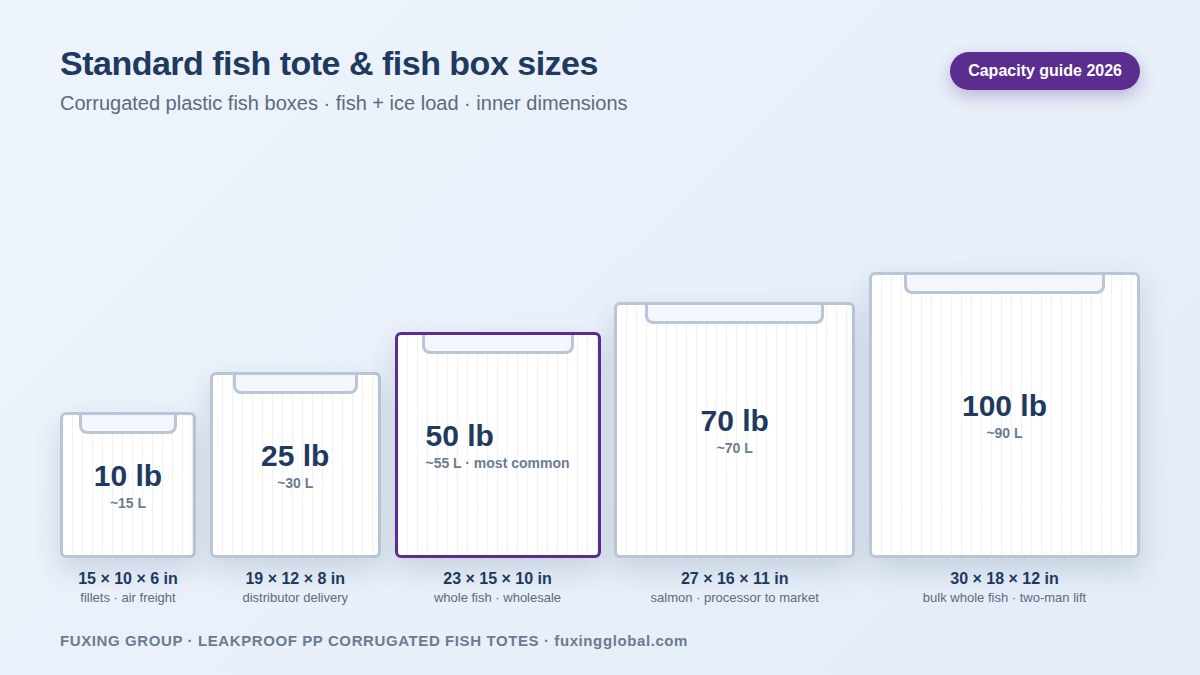
Sizes below are typical industry dimensions for single-trip and limited-reuse fish boxes. Exact outer dimensions vary by maker; what matters for buyers is the fish capacity, the pallet footprint, and whether the box drains melt-water safely.
| Nominal size | Typical inner dimensions (L × W × H) | Approx. volume | Fish + ice load | Common use |
|---|---|---|---|---|
| 10 lb box | 15 × 10 × 6 in (38 × 25 × 15 cm) | ~15 L | 10 lb fish + ice | Fillets, portioned retail, air freight samples |
| 25 lb box | 19 × 12 × 8 in (48 × 30 × 20 cm) | ~30 L | 25 lb fish + ice | Fresh fillets and whole small fish, distributor delivery |
| 50 lb box | 23 × 15 × 10 in (58 × 38 × 25 cm) | ~55 L | 50 lb fish + ice | Whole fish, wholesale, the most common “fish box” |
| 70 lb box | 27 × 16 × 11 in (69 × 41 × 28 cm) | ~70 L | 70 lb fish + ice | Salmon and larger whole fish, processor-to-market |
| 100 lb box | 30 × 18 × 12 in (76 × 46 × 30 cm) | ~90 L | 100 lb fish + ice | Bulk whole fish, short hauls, two-man lift |
| Bulk insulated tote | 48 × 43 × 26–43 in | 300–800 L | 300–800 lb | Dockside offload, processing plants (rigid PE, forklift) |
Dimensions are typical, not universal — OEM makers (including Fuxing) build to your exact internal dimensions and drain-hole layout.
Pallet math
Start with the actual box outer dimensions and the pallet or slip-sheet specification. Calculate units per layer, then validate loaded stack height, compression, restraint and handling under the intended temperature and moisture conditions. Nominal weight labels alone do not determine a safe pallet pattern.
How much ice?
- Validated program: use the processor's approved icing or coolant plan for the species, starting temperature, route, duration and ambient exposure.
- Usable capacity: include the approved seafood load, ice or coolant, liner, headspace and lid clearance.
- Temperature evidence: verify the packed system with a representative route trial and temperature records.
- Drainage: specify the melt-water path, holes or false bottom, then test the finished box and pallet stack.
Material Comparison: EPS Foam vs Waxed Cardboard vs Corrugated Plastic
The 25–70 lb distribution sizes come in three main materials. The right choice depends on trip length, reuse plans, and what your receiver can recycle.
| Property | EPS foam box | Waxed cardboard box | PP corrugated plastic box |
|---|---|---|---|
| Water exposure check | Verify seams, lid fit and damage | Verify coating, edges and exposure time | Verify joints, edges, drain path and closure |
| Insulation check | Test the complete pack and route | Test the complete pack and route | Test sheet construction and any liner as a system |
| Reuse potential | Depends on damage, sanitation and return system | Usually specified as one-way; verify | Candidate for a controlled loop after trip, sanitation and inspection trials |
| Receiver recycling | Ask the named receiver or local program | Confirm coating acceptance with the local program | Confirm the complete construction with the local program |
| Wet stacking strength | Test loaded finished boxes | Test after representative moisture exposure | Test loaded finished boxes, joints and edges |
| Freight (empty, nestable/flat) | Bulky | Ships flat | Ships flat |
| Printable branding | Limited | Yes | Yes (screen/flexo) |
| Cost per successful trip* | Use delivered purchase and disposal cost | Use delivered purchase and disposal cost | Model cleaning, return freight, damage, loss and measured trips |
*Cost depends on size, construction, volume, damage, cleaning, return freight, loss and actual successful trips. Test the route before selecting a returnable format. See the waxed seafood box comparison.
When each material wins
- EPS foam: long unrefrigerated hauls and air freight where insulation matters most.
- Waxed cardboard: lowest upfront cost — but landfill fees and lost repulping value are pushing many receivers away from it.
- PP corrugated plastic: a candidate for wet cold-chain routes or controlled return loops when joints, drainage, low-temperature impact, stacking, sanitation and end-of-life route are validated.
Spec Checklist Before You Order
- Capacity: approved fish load + validated ice or coolant allowance + required headspace and lid clearance.
- Footprint: must tile your pallet (48 × 40 in US standard) with minimal overhang.
- Wall thickness: 3–5 mm PP corrugated sheet is typical for 25–70 lb fish boxes; heavier loads or repeated reuse call for 5 mm+ or edge reinforcement.
- Drainage: drain holes sized and placed so melt-water leaves without draining onto boxes below.
- Food contact: request declarations and reports matched to the exact material, SKU, plant, seafood use and destination requirement.
- Print: brand, species, catch area, handling icons — one-color screen print is cheap at volume.
- Origin & duties: U.S. buyers should give the broker the product construction, use, manufacturing steps, producer/exporter and origin records, then confirm written scope, current instructions and all other duties. Use the plant and origin checklist.
FAQ
What sizes do fish totes come in?
Standard steps are 10, 25, 50, 70 and 100 lb (about 15–90 L). Dockside bulk totes run 300–800 lb. Distribution mostly uses 25–70 lb boxes that tile a 48 × 40 in pallet.
How much ice do I need per pound of fish?
Use the processor's validated icing and temperature-control program for the species, starting temperature, route, duration and ambient exposure. Size the box for the approved fish load, ice or coolant, headspace and drainage.
Are corrugated plastic fish boxes reusable?
Some constructions can be candidates for a controlled return loop, but successful trips depend on joints, damage, sanitation, inspection, loss, return ownership and route. Recycling depends on the complete construction and the local collection program.
What is the difference between a fish tote and a fish box?
“Tote” usually means a rigid reusable dockside container; “box” usually means a lighter single-trip or limited-reuse shipping box (EPS, waxed cardboard, or corrugated plastic). In the 25–70 lb sizes the words are often used interchangeably.
Can fish boxes be printed with my brand?
Printing may be available by screen, flexographic or other methods depending on the substrate, treatment, artwork and durability target. Ask the quote to state the proposed print process, dimensional tolerances, tooling and MOQ, then approve a production-representative sample.
Where can I buy corrugated plastic fish boxes if tariffs are a concern?
Ask the broker or trade counsel to compare the product construction and use with the written order scope, then confirm actual origin, producer/exporter, current instructions and all other duties. A proposed Philippine shipment is not a zero-duty guarantee.
Need Fish Boxes Built to Your Spec?
Fuxing Group offers custom PP corrugated fish-box and tote constructions from proposed plants in the Philippines or Vietnam. Request SKU-specific material records, drain/joint options and a representative route-trial plan.
Request a Test-Ready Quote